Jason Huang

We often hear phrases like "tight tendons" or "stiff muscles," yet few people pay close attention to this issue, let alone ponder what causes this tightness. What exactly is happening from an anatomical perspective? From my point of view, many tightness issues—or what is traditionally referred to as high muscle tone—are actually the result of compression or insufficient space caused by soft tissue deformation. This new concept might be somewhat difficult to grasp at first, as it requires moving beyond the traditional view of looking solely at muscles or fascia in isolation, and instead establishing a new "concept of soft tissue space."
What Is Soft Tissue Space?
The term "soft tissue" generally refers to all non-bony tissues in the body. Muscles, fascia, nerves, and blood vessels do not exist independently; rather, they form a continuous, interdependent, three-dimensional structure. Therefore, we refer to this entire structure collectively as soft tissue. Under normal conditions, every soft tissue—both within itself and between adjacent tissues—should have "space" to maintain proper gliding, mobility, and physiological metabolic circulation.
We call them soft tissues because they are soft, and a key characteristic of soft matter is that it can "shift and deform," whereas rigid tissues (bones) do not. Soft tissues adapt and change along with our body posture and state of exertion. For example, when we bend an elbow, squat, or raise an arm, what changes is not merely the length of a specific muscle; rather, the muscles, fascia, skin, and other soft tissues across the entire region must collectively undergo deformation.
Therefore, performing human movement is not the work of a single muscle or fascia alone, but the result of the collective participation of all surrounding soft tissues.
Why Do Soft Tissues Change?
Soft tissues attach to bones and joints, making up the entire human body. If you look closely at a human skeleton model, you will notice many spaces, including uneven gaps between bones, joint spaces, and cavities housing internal organs. These spaces must be filled by all the soft tissues to form a complete bodily structure.
As mentioned earlier, these tissues are "soft." When soft tissues occupy these gaps over an extended period, they can become trapped inside the crevices due to sustained flexed positions of the limbs—this is especially true for fascia and skin tissues, which is how joint creases and wrinkles are formed.
Soft Tissue Deformation in a Relaxed State
For instance, when the elbow joint remains bent for a long time, such as being immobilized in an arm sling or kept stationary for too long, it becomes difficult to straighten the arm. The reason is that, while fixed in a flexed state, the soft tissues sequentially shift, compress, or sink into the joint space, becoming molded into a deformed state (accumulating or crowding together). This compression and deformation cause the tissues to gradually dehydrate and lose their nutrient supply, while also preventing metabolic waste from being eliminated. Even though the elbow joint itself is not injured, it cannot fully straighten. If you press firmly on the soft tissues around the elbow joint, it typically triggers a painful response, which is the cumulative sensation of soft tissues being compressed together. Once these soft tissues are freed and opened up, creating space and elasticity, pressing on them will no longer cause pain or soreness.
Soft Tissue Deformation Under Exertion
Imagine someone's posture while working on a computer or lying down scrolling through a phone. The chest is in a collapsed, flexed position. At this point, the soft tissues of the shoulder joint and thoracic rib area are squeezed toward the chest cavity, the space between the clavicles, and the intercostal spaces—which is why some people develop sunken areas beneath the collarbones and sternum. In this state, simply pressing lightly on the sternum or the sternoclavicular joint will cause them to feel pain or tenderness.
Moreover, most people have likely experienced exerting force while holding a joint in a bent position. Examples include carrying heavy objects with bent arms (causing elbow stiffness and difficulty straightening), or being made to hold a squat or do frog jumps (leading to hip tightness and difficulty extending the thighs). When soft tissues move along with limbs or motions while exerting force in a flexed posture, they become fixed in a shortened position. At this time, not only are the spaces between bones filled, but the inter-soft-tissue spaces (including the gaps between muscles) also become fixed and shaped due to compression. I will elaborate on this in a separate article in the future.
In summary, whether under exertion or in a stationary, immobilized state, soft tissues undergo deformation. Consequently, human soft tissues undergo deformation every single day; people just rarely pay attention to it unless they feel something unusual. You might have had the experience of feeling sudden, unexplained pain that simply resolved after moving around or sleeping on it. In reality, this is because bodily movement helped restore and reset the deformed soft tissues!
In Fact, Soft Tissue Deformation Begins in Childhood!
The sudden, short-lived pain mentioned above actually happens much more frequently during a child's developmental stages. I remember as a child spraining my ankle playing basketball; after walking it off, I could continue playing the next day. This is a state where soft tissue space is still preserved. The purpose of soft tissue space is to accommodate deformation; however, when deformed to the absolute limit, that space runs out. Once the space is gone, it is no longer the superficial skin and fascia that get sprained, but the deeper ligaments (Figure 1).
Classified by firmness, softer tissues include the skin, fascia, subcutaneous fat, and muscles. Tendons are firmer because they must transmit force, and the firmest soft tissues are ligaments, as they secure bone to bone. When the softer outer layers of soft tissue run out of space, they can no longer undergo normal deformation to adapt to movement or external forces. In plain terms, without space in the outer soft tissues, movements feel restricted and unable to extend, accompanied by a sensation of tightness. When the outer layers have no room to deform, deeper soft tissues are forced to deform instead—because the outer deformational space exists precisely to absorb this deformation.
A child's soft tissue space continuously expands due to cell division and growth, which is one reason why unexplained pains occurring without external trauma often resolve in a day or two. However, based on my frequent clinical observations of child and adolescent athletes, soft tissues that feel hard and have already developed persistent tightness rarely recover simply by moving around, stretching, or passive relaxation. This is because, in addition to the muscular ends, the joint structures have also deformed to the point where no space remains. This phenomenon is especially prevalent among youth athletes who specialize early and train almost exclusively in a single sport. This is precisely why I continually encourage young athletes to participate in multiple sports.
Further Reading: Childhood Development, Training, and Fascial Space | Jason Huang
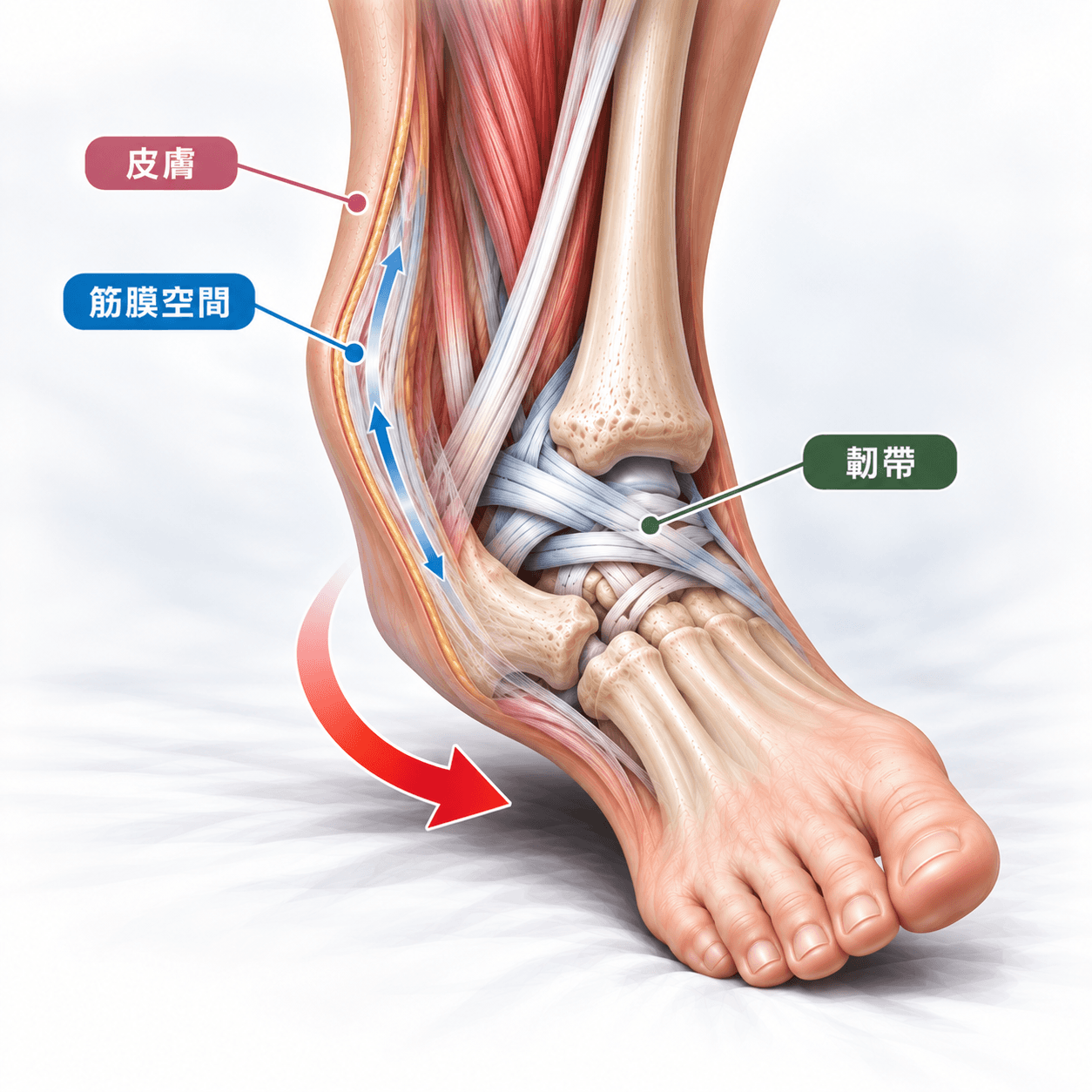
Figure 1: Ankle inversion motion. When outer spaces (skin, fascia) can deform, lengthen, and stretch, the ligaments (anterior talofibular ligament or calcaneofibular ligament) are far less likely to be injured.
Traditionally, we believe that tight muscles are prone to strains and that misaligned joint angles (such as knock-knees) are prone to sprains. In reality, both are related to soft tissue space and soft tissue alignment. Hamstring strains in track and field athletes often stem from prolonged sitting that reduces soft tissue space behind the thighs; anterior cruciate ligament (ACL) tears in basketball players often result from overall soft tissue deformation across the hip, knee, and ankle joints leading to restricted space; ankle ligament sprains in soccer players often arise from a loss of soft tissue space around the ankle.
Body stiffness simply means that soft tissues have been compressed and lost their space to glide and shift. Conversely, a resilient, supple body is one where soft tissues maintain their original space. With elasticity comes strength; with elasticity comes shock absorption; with elasticity comes extensibility. Therefore, preserving soft tissue space is a goal and direction that everyone should strive for in their daily lives.


