
Jason Huang

Over the past decade, myofascial release methods have become increasingly diverse. Manual massage, IASTM (Instrument Assisted Soft Tissue Mobilization), foam rollers, massage balls, vibration guns... all of these tools have their own value. However, after long-term study of muscle, fascia, and skin, and years of practical experience with IASTM, I began to ponder a more fundamental question: What exactly are we "releasing"?
If a person's soft tissue has already deformed—where the subcutaneous space, the space between muscles, and the space around bony prominent areas have narrowed, or even local depressions have appeared—then what we really need to address might not just be "tight muscles". The issue likely lies in—the original alignment, space, and gliding pathway of the soft tissues have altered.
This is also why I started developing the Fasyroll® Myofascial Roller in 2024. What I wanted to create was a tool that could target soft tissue deformation, recreating tissue gliding and space in a comfortable and pain-free way.
Release shouldn't just be about "pressing tight areas to loosen them"
The human soft tissue is not a structure where pieces are separated from each other. From the skin, subcutaneous fat, and superficial fascia, to the deep myofascia, muscles, and tendons, all layers of tissue require a certain degree of relative gliding between them.
When the alignment and gliding pathways of these tissues change, I refer to this state as soft tissue deformation. Some deformations are easily visible from the outside: depressions appear in areas that should be plump, or lines become deeper; others require palpation or movement to detect. My logic of operation is not to constantly search for the "most painful point", but rather to look for: Where is it being squeezed? Where is it depressed? Where has it lost its original, proper space? Therefore, the purpose of Fasyroll® is not to press deeper into the tissue, but to try to recreate relative displacement in the tissues that have already squeezed together.
Why "Double Rollers"?
This is the most important part of the entire design. When a typical single tool contacts the body, the easiest thing to generate is pressure. However, when two rollers contact the skin simultaneously and form relative displacement during the rolling process, they can generate the Rolling Shear Force that I desire.
The two rollers of Fasyroll® are not just simple, smooth cylinders; they feature an interlocking structure. The purpose of this design is to allow the rollers, when moving, to generate not just linear force, but to increase the contact volume of soft tissues producing displacement and shear. This is also the core concept I explain in my courses: "Double Roller Effect → Directional Shear Stress → Interlocking Structure Increases Displacement Volume".
More importantly—it is rolling. As long as the tool keeps moving forward, the shear force can move along with it. Therefore, I call it: Continuous Rolling Shear (Figure 1).

Figure 1. Continuous rolling shear force generated by the double rollers.
Effective release should be comfortable!
In the past, many people had the impression that myofascial release is more effective the more painful it is. However, pain itself is actually not a necessary condition for determining the efficacy of soft tissue treatment. I hope to utilize rolling to generate shear and cause relative displacement between soft tissues without the need for heavy downward compression. Therefore, during correct operation, what I pursue is a comfortable, pain-free, or mildly sore sensation, and treatment efficacy should not be indicated by bruising or extensive petechiae (sha).
This point actually aligns with the increasingly conservative view in current IASTM literature regarding "petechiae/sha". Relevant clinical guidelines point out that excessive pressure and friction from release tools may cause petechiae (pinpoint bleeding); the literature even reminds us that this may represent iatrogenic tissue trauma, and therefore petechiae, bruising, and pain should not be viewed as goals that treatment must pursue (PubMed Central).
Myofascial Roller and IASTM tools are very different!
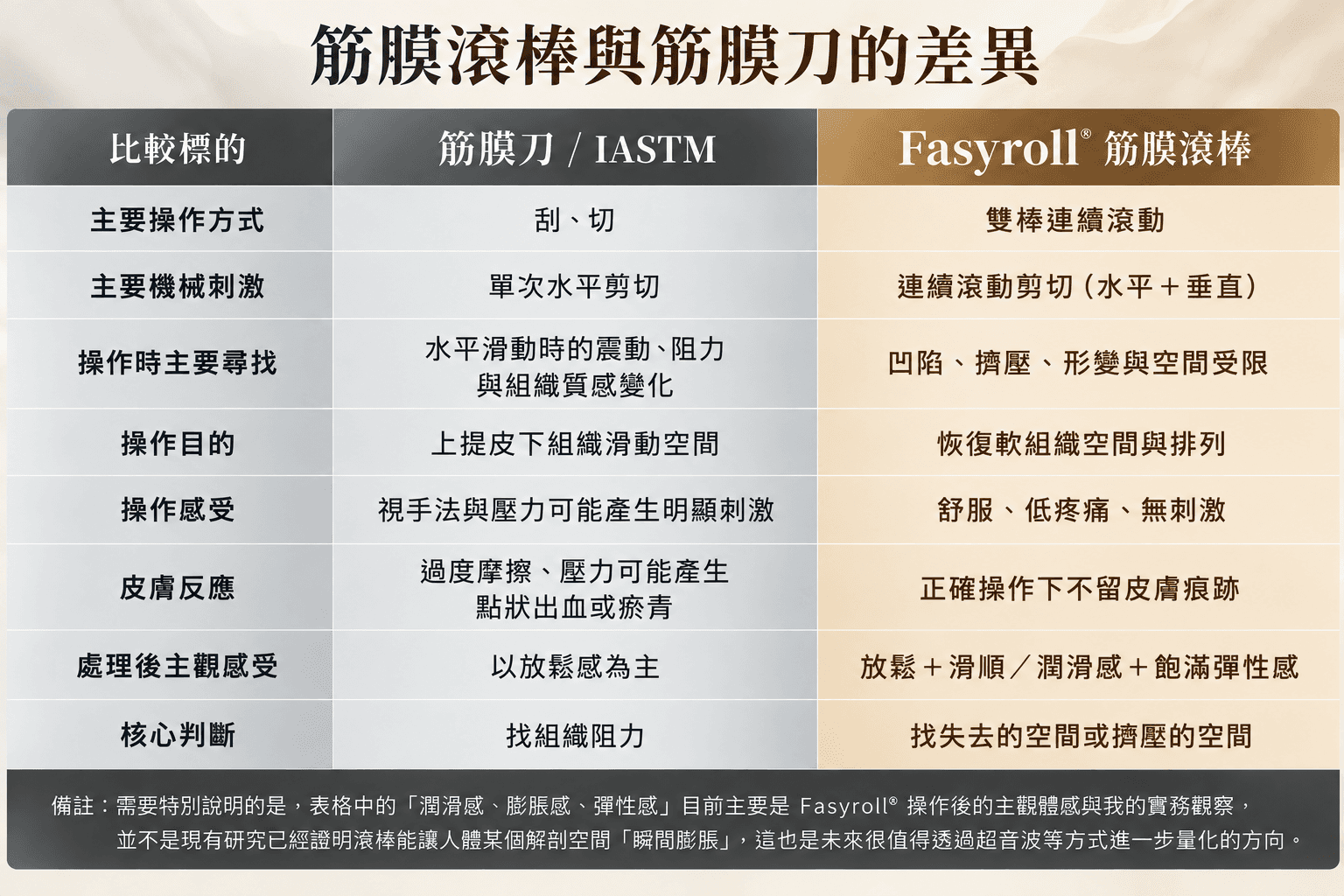
Since 2019, I have dedicated myself to IASTM education in Taiwan, so for me, Fasyroll® is not meant to negate IASTM tools. The value of both tools is different, and most importantly—they address different issues respectively (Table 1).
Table 1. Comparison table of differences between Myofascial Roller and IASTM tools
"Plumpness" is actually reclaiming the soft tissue space that should have been there
This is a very interesting feeling that many people describe after using the myofascial roller. It's not just "loose." Instead, they feel that area is plumper, more elastic, smoother, and there is even a sense of lubrication during joint movement. My current explanation or hypothesis for this phenomenon is understood through soft tissue space.
When soft tissue deforms, local tissue may gather or be compressed toward a certain area, restricting the original subcutaneous space and relative gliding between tissues (as shown in the animation below). The operation of Fasyroll® is to follow the depressions, squeezes, and restricted positions, utilizing continuous rolling shear to try to recreate relative displacement in the tissues. Therefore, "plumpness" should not be understood as making the muscles bigger, but if limb circumference is measured, it might show an increase, which remains to be verified by future scientific research.
The vibration function of the roller is to "move soft tissues"
Another feature of the Fasyroll® Myofascial Roller is its perceptible vibration. My purpose in using vibration is not to increase painful stimulation, but rather to provide additional mechanical force during the rolling process to drive the mobility of soft tissues.
Although vibration itself has some basis in human research, including its ability to acutely increase peripheral blood flow, the effect is influenced by the form and frequency of vibration. Furthermore, a 2026 latest scoping review on skin blood flow on PubMed also points out that the effect of vibration on blood flow is highly context-dependent, with frequency, amplitude, application site, and duration all altering the results. Therefore, I will not introduce the aforementioned mechanisms as the primary selling point of the myofascial roller, but will position the vibration function as an auxiliary mechanical force to assist in soft tissue movement, rather than treating "vibration" alone as the source of efficacy.
Almost everyone needs good soft tissue space and gliding
I believe the target audience for myofascial rollers is very broad. It's not just for athletes, nor is it only for people in pain. Sedentary office workers, regular exercisers, fitness enthusiasts, ball game athletes, middle-aged and elderly individuals, or even those who just feel "stiff or restricted" in a certain part of their body can potentially reclaim their original physical state from the perspective of soft tissue space and gliding. However, "applicable to almost all populations" does not mean "applicable in all situations." For example, open wounds, infections, acute inflammation, fractures, or dislocations are not suitable for direct operation; conditions such as pregnancy, high blood pressure, diabetes, post-surgery, or post-trauma also require adjustment based on individual state or professional assessment first.

From "muscle relaxation" to "restoring soft tissue space"—increasing space equals reducing compression.
If the problem is deformation, address the deformation. If the problem is compression, find the space back. If the problem is loss of gliding between tissues, find a way to recreate relative displacement. The Fasyroll® Myofascial Roller was designed starting from this very question. Future human release tools will certainly move in the direction of being more comfortable, more efficient, and closer to addressing the root of the problem. We look forward to creating more new inventions that contribute to human health in the future.


