Jason Huang

Over the past few decades, research in sports science and sports medicine has primarily focused on muscles. Whether it is strength training, sports injuries, flexibility, or fatigue recovery, most studies have targeted muscles as the main subject of investigation.
Over the past twenty years, with advancements in anatomy, biomechanics, and imaging technology, the research focus has gradually shifted to fascia. Researchers have begun to discover that fascia is not merely a membrane wrapping around muscles, but rather a vital system that spans the entire body, connects various tissues, and participates in force transmission, movement control, sensory feedback, and pain regulation.
As seen in recent bibliometric analyses, the number of published fascia research papers continues to increase, with no signs of slowing down. Recent research topics have further extended to chronic pain, ultrasound imaging, Shear Wave Elastography, extracellular matrix (ECM), fibroblasts, neuromodulation, and immune responses, indicating that fascia research is still in a phase of rapid development rather than having peaked (Du et al. 2023; Zieliński 2025; Gromakovskis et al. 2025).
However, among the many studies on fascia, one tissue that is the outermost layer of the human body and is closely linked to the superficial fascia has rarely received attention—the skin.
Skin and Fascia Are Actually a Continuous System
Modern anatomy has confirmed that the dermis and superficial fascia are not independent of each other, but form a three-dimensional continuous system through a large number of fibrous structures (Retinacula cutis, or skin ligaments).
These fibrous structures act like bridges, anchoring the skin to the superficial fascia, while allowing both to bear tension, compression, and shear forces together during human movement. Therefore, the skin and superficial fascia are not two unrelated layers, but a functional unit that works together.
The Human Body Deforms Skin and Fascia Every Day
Every time the human body walks, runs, squats, raises hands, bends, turns, or even just sits, it causes the skin and superficial fascia to undergo simultaneous stretching, compression, sliding, and twisting.
In other words, the skin is not just a protective layer covering the surface of the human body, but the tissue that first contacts the outside world and first experiences mechanical stress during human movement.
Due to the structural continuity between the dermis and superficial fascia, their mechanical behaviors can also affect each other. Therefore, the formation of wrinkles and skin folds may actually be related to fascia, rather than being just a skin problem. The generation of human body folds is like an uneven bedsheet; the deeper the folds, the less space there is in other positions, because a bedsheet is a unit, just like the skin and superficial fascia, which connect the whole body into one unit. When we sit for a long time, the front of the hip joint forms the largest fold on the human body, and the skin and fascia sink into the space in front of the pelvis, which is why hip mobility is restricted (Figure 1). This is a huge gap from the previous understanding that it is caused by tight hip flexors. One is from the perspective of skin and fascia, and the other is from the perspective of muscles. This is also why we need to change our perspective when interpreting the human body, because in the past, we always approached problems by thinking about changes in muscle patterns, which could only solve part of the problem.
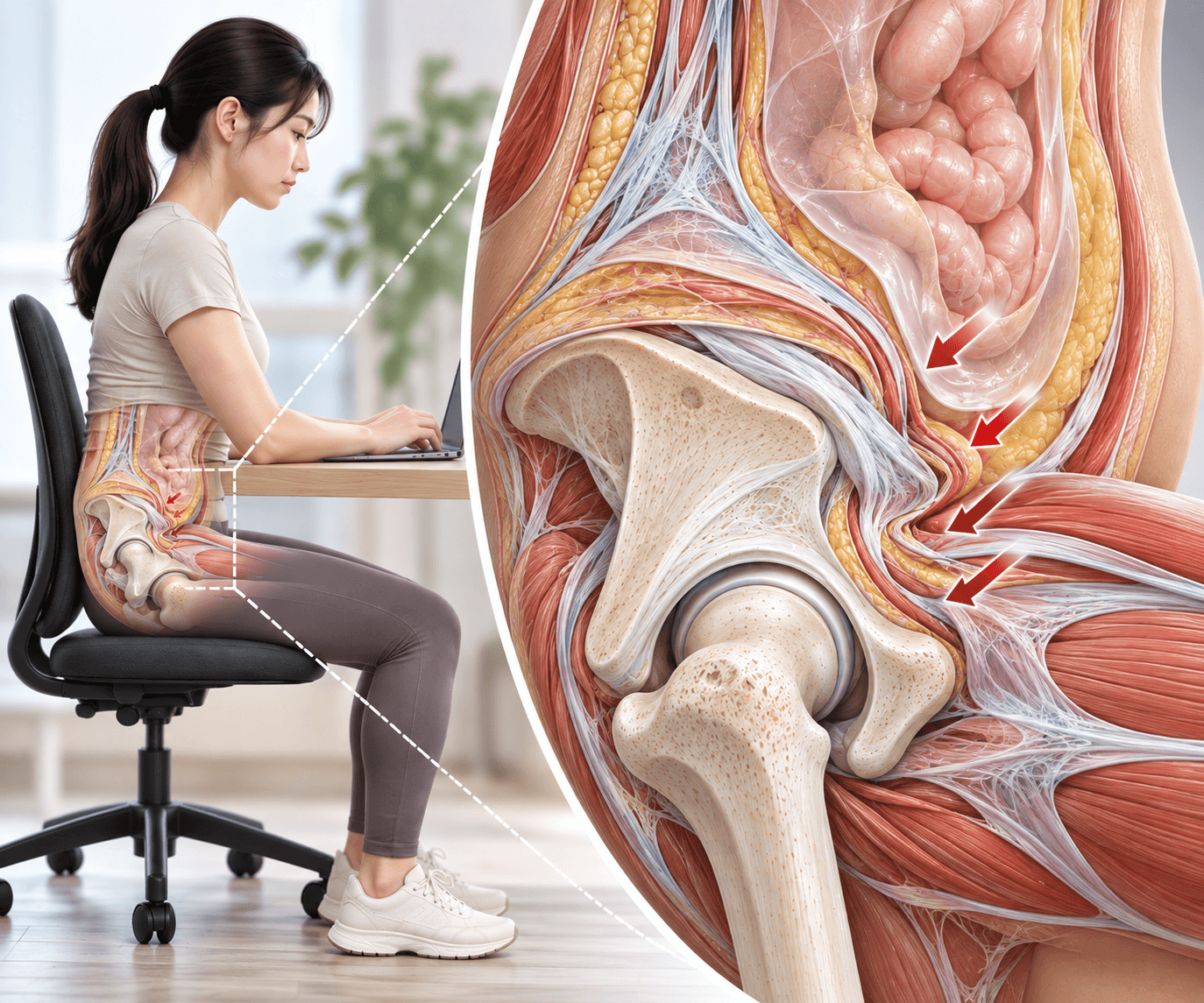
Figure 1. Deformity of abdominal and hip joint soft tissues caused by prolonged sitting.
Issues Faced by the Skin-Fascia Interface
"Skin faces internal and external environmental challenges almost every day." In addition to repeated mechanical deformation, the skin also accumulates various substances from body metabolism and the external environment every day, such as:
Dead skin cells
Sweat
Sebum
Dust
PM2.5 and air pollutants
Pollen
Microbes and fungi
Residues of sunscreen, cosmetics, and other topical products
If these substances remain on the skin surface for a long time, they may affect the skin barrier function, microecological balance, and local inflammatory reactions (Figure 2). Therefore, cleaning the skin will be a major focus of human health care. If we understand the continuous relationship between skin and fascia, it is not hard to understand that cleaning the skin might just solve fascia problems.

Figure 2. Many substances generated by internal and external environments remain on the skin, which may subsequently affect the fascia.
Therefore, we propose the following research hypotheses, as a starting point to welcome interested researchers to explore together.
Does skin cleansing affect the sliding ability of superficial fascia?
Does skin condition affect fascial neural sensitivity?
Can skin cleansing affect physical performance and subjective tightness?
In terms of application, a question worth considering in the future might not be: "What should be done when a fascia problem occurs?" but rather "If we address the skin problem, will the fascia problem be resolved?"
If cleaning the skin can maintain fascial health, could daily cleansing become the best way for chronic pain, strength training, sports injuries, flexibility, or fatigue recovery?
---------------------------------------------------------------------------------------------------------------------
"Fascia Plus Lab proposes the 'Skin–Superficial Fascia Interface' as a new research concept worthy of in-depth exploration. We believe that the structural continuity between skin and superficial fascia not only has anatomical significance but is also highly likely to have important effects on human movement, sensation, and body maintenance. More basic and clinical research is still needed in the future to jointly validate this hypothesis."
Disclaimer | The content of this article is only for health science popularization and physical maintenance knowledge sharing. It does not constitute any medical diagnosis, treatment, or medical advice, nor can it replace professional medical advice. If you have health concerns, please consult a qualified healthcare professional.


