Jason Huang

Today's children are entering competitive sports earlier and earlier.
Starting from elementary school, they focus on a single sport, training four or five days a week, with weekday practices, weekend games, and intensive training during winter and summer vacations. When a child shows talent, it is natural for parents or coaches to think:
"Does specializing earlier and training more lead to greater competitiveness in the future?"
But for most sports, specializing earlier does not necessarily mean better performance in the future.
Studies indicate that entering "single-sport, year-round, high-repetition training" too early in childhood and adolescence may increase the risk of overuse injuries and burnout; for most sports, there is currently no evidence proving that early specialization is a necessary requirement to achieve high competitive levels in the future (Myer et al., 2015; LaPrade et al., 2016).
In fact, what truly deserves our concern is not just:
"Is the child performing well right now?"
But rather:
"Is their body ready to handle this training?"
Observe if your child is experiencing any of the following seven states:
1. Recurring pain in the same area
There are no obvious bumps or sprains, yet knees, heels, shoulders, elbows, or the lower back are repeatedly uncomfortable.
This may indicate that repetitive loading is gradually exceeding the tissue's ability to recover. Overuse injuries are often associated with repetitive loading and insufficient recovery (DiFiori et al., 2014).
When the body starts to experience pain, it often means the problem did not just happen today, but is the result of long-term accumulation that has been ignored.
If there are no obvious external forces like collisions or strains, but the body starts to hurt on its own, it may mean that local soft tissues have been squeezed or excessively pulled for a long time, and the original space for movement and sliding is becoming smaller and smaller.
Pain may just be the body telling you: there is no longer enough space here to continue compensating.
2. Pain starting near growing bones
Children are not miniature adults.
Growing bones and growth plates are still in the developmental stage, and special attention must be paid to overuse injuries when facing large amounts of repetitive loading (DiFiori et al., 2014). For example, Osgood-Schlatter disease, Little League shoulder, and gymnast's wrist can all appear in growing athletes. So when a child repeatedly complains of knee, heel, or shoulder pain, do not dismiss it as just "growing pains."
Bones do not exist in isolation. The surface of the bone has the periosteum, and surrounding it are connective tissues such as tendons, ligaments, joint capsules, and fascia, which are all closely connected. Therefore, when we feel "bone pain," the source of pain does not necessarily come from the bone itself; it may also be related to the pulling, squeezing, or change in space of the surrounding soft tissues. So, bone pain is not necessarily just a bone problem.
3. Left-right body differences are becoming increasingly obvious
Long-term repetitive unilateral movements like throwing, kicking, or swinging a racket lead to a certain degree of left-right difference in the body, which is a common adaptive phenomenon in specialized sports.
But it is not just sports training that causes body asymmetry. Daily life habits also unconsciously shape our bodies. For example, lying on one side to watch TV for a long time, writing with one hand propping up the head, habitually crossing legs, slouching, or maintaining poor sitting posture can cause the body to tilt towards one side for a long time, gradually accumulating originally subtle left-right differences.
When asymmetry in life is layered with high-frequency, unilateral specialized training, the original differences may be further amplified.
Since the body is an interconnected system, the problem will not just stay in the most frequently used hand or foot. Over time, compensations and changes can occur from the shoulders, torso, and spine to the pelvis.
What truly needs attention is not that the left and right sides of the body are completely different, but whether these differences are continuously being amplified, even starting to affect movement and body coordination.
Therefore, you should observe your child's posture more in daily life, as well as their posture and left-right differences in movements like running, jumping, throwing, and kicking. Parents and coaches can also remind children at appropriate times to maintain good posture, making "sitting upright and standing tall" a daily habit.
But if a child always needs to be reminded, or even has to deliberately exert force to "align" their body, the problem cannot be attributed solely to postural habits or lack of muscle strength. At this point, you should also observe further to see if there is an imbalance in soft tissue tension, alignment, or movement space.
When soft tissues are squeezed, pulled, or deformed for a long time, muscles may need to exert more force just to maintain the body in an ideal position.
Therefore, what we pursue should not just be demanding the child to "chest up, sit straight," but restoring more appropriate soft tissue space and movement conditions for the body, so that the muscles do not have to constantly fight against the body's original limitations.
Good posture should not be "held up" by force, but should be easily maintained by the body in a natural, relaxed state (Figure 1).
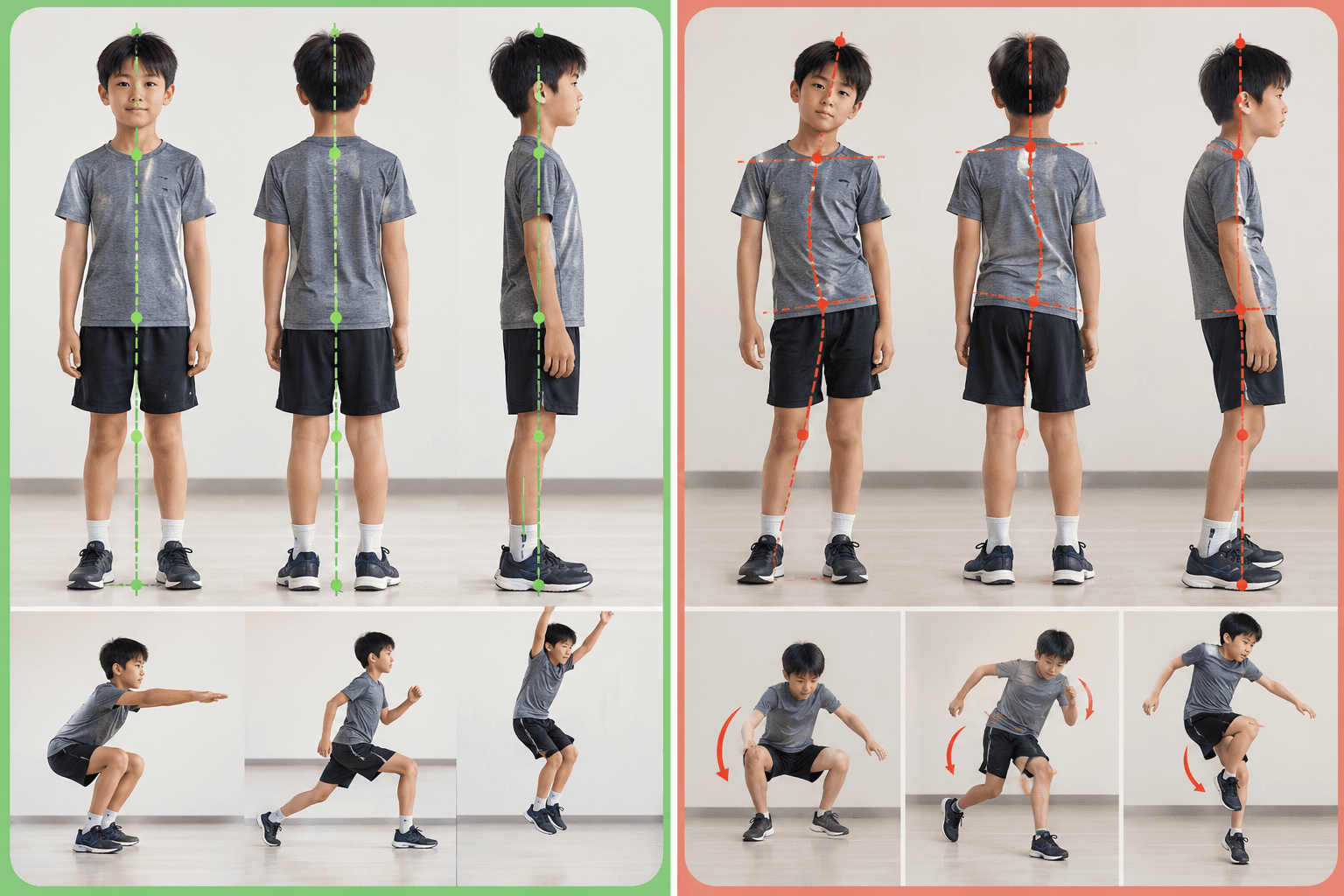
Figure 1. Good posture versus posture with left-right deviation and their athletic ability test results.
4. Performing very well in their sport, but poorly in basic movements
They kick the ball very well but cannot stand steadily on one foot; they jump very high but have poor landing control; they swing the racket very fast, but basic running, jumping, squatting, and turning are uncoordinated. Actually, specialized ability does not equal complete fundamental movement ability.
When a child repeats the same specialized movement over a long period, the body will gradually find the "most familiar way" to complete the task. Even if some joint mobility is restricted, left-right strength is uneven, or basic movement control is poor, the body may still compensate through other parts to throw the ball, kick it far, or even achieve great specialized results.
Therefore, performing well in a sport does not mean every part of the body is functioning well; sometimes, good results actually mask underlying movement problems.
Parents or coaches can look out for these warning signs
If your child shows any of the following situations, it is worth paying closer attention:
Unstable single-leg stand: The stability of the left and right legs is very different, or they easily wobble and lose balance.
Squat obviously tilting to one side: When squatting, the body leans, the pelvis rotates, or the knee movements on both sides are obviously different.
Poor landing control: Unstable and wobbling when landing from a jump, or always habitually using the same leg to bear the weight.
Large difference in left-right mobility: For example, one shoulder raises high while the other gets stuck, or the range of turning left and right is obviously different.
Obviously asymmetrical running posture: Obvious differences in arm swings on both sides, stride size, or the way the soles of the feet land.
Uncoordinated when changing movements: They perform specialized movements very well, but look clumsy when encountering unfamiliar movements like lateral movement, backward running, lunging, or turning.
Always using a fixed side: Not just in sports, but even standing, sitting, carrying a backpack, or holding things are habitually tilted to the same side.
Movement requires a lot of effort to "do straight": Once they relax, they easily lean, and they must deliberately control themselves to maintain posture.
Starting to experience recurring tightness or pain: Especially always occurring in the same location, or the recovery time after training is getting longer and longer.
What truly needs attention is not that the child is completely symmetrical on both sides, but whether the differences are getting bigger, whether basic movements are getting worse, or if pain has already started to appear or affect sports performance.
Specialized skills can become proficient through a large number of repetitions, and can even be completed by compensation; but balance, coordination, stability, mobility, and multi-directional movement capabilities are the important foundations supporting a child's long-term athletic development.
Do not just look at "how well the child plays the game," but also look at "how well their body moves."
5. The body gets more and more "stiff" with training
Large-range movements like squatting, turning, stretching, and raising hands that could originally be completed easily, instead see a gradual decrease in range of motion as training time increases, even requiring more compensation such as twisting the waist, shrugging shoulders, or leaning to one side to complete. This is a change worthy of attention for parents and coaches.
Repeating the same specialized movements over a long period, the body will gradually adapt to specific ways of exerting force and ranges of motion. If there is a lot of training but a lack of sufficient recovery, multi-directional activities, and basic movement practice, the child may become more and more proficient in specialized movements, but overall movement choices for the body will become fewer and fewer.
Parents or coaches can specifically observe: whether the child used to be able to squat down but now easily gets stuck; whether turning used to be natural but now the left and right sides are very different; whether raising hands and bending over used to be easy but now require help from other parts.
"Getting stiff" in itself is not a diagnostic criterion for overtraining, but if it is accompanied by recurring pain, increased fatigue, slower recovery, expanding left-right differences, or a recent significant increase in training volume, it is worth re-evaluating the current training and recovery arrangements.
Good training should give children more movement capabilities, rather than making them better and better at one movement while becoming worse and worse at others.
6. The more they train, the worse their performance gets
A continuous decline in speed, power, accuracy, or fitness is sometimes not because of "not training enough," but may be because training and recovery have lost their balance. When we observe a child's training state, one of the most direct ways is to see "if their movements have changed."
When you find that your child's running posture starts to look unnatural, they obviously cannot jump high when driving in for a layup, movements they could originally do become more and more difficult, or they even have little desire to move after returning home from training, these changes deserve more attention from parents and coaches.
These phenomena do not necessarily mean injury, but may reflect that the child's fatigue, recovery, or soft tissue state has begun to change. If training continues to increase without addressing the underlying causes, what was originally just "weird movements and a stiff body" may gradually develop into recurring tightness, soreness, or even pain over time. Intensive training in children and adolescents without proper recovery may increase the risk of overtraining and other negative physical and psychological outcomes (Brenner, 2016; DiFiori et al., 2014).
The intention of training is to make the body better and better, which is a dynamic process. Therefore, the principle of gradual progression and correct recovery strategies should be grasped so that real training progress can be achieved. The real training process should be: Stimulus → Recovery → Adaptation → Progress. In this way, we can safely nurture the future pillars who keep making progress.

Figure 2. The process of normalized training.
Sometimes, what a child lacks is not the next training session, but a real recovery.
7. The child starts to not want to exercise
This may be the warning sign that requires the most attention from adults. Fatigue, mood changes, loss of enjoyment in sports, and even starting to resist sports they originally liked are all worth noting to see if there are issues with overtraining or burnout. Early high specialization is also associated with issues such as burnout, reduced sports motivation, and dropping out of sports (Myer et al., 2015; LaPrade et al., 2016).
At this time, do not just ask: "Why don't you want to train?"
Perhaps we should ask: "Do you still like this sport?"
Do we want to raise a "young athlete" or someone who can play sports for a long time?
Seeing that a child has talent, we naturally hope they do not lose at the starting line. So we look for better coaches, increase training, and participate in more competitions, hoping they get stronger earlier. But we often forget: the child's body is still growing.
The American Academy of Pediatrics points out that for most sports, later specialization may be more beneficial for long-term athletic goals; participating in multiple sports before puberty also helps reduce the chances of injury, stress, and burnout (Brenner, 2016). So running more, jumping more, throwing more, catching more, turning more, and experiencing different sports during childhood is not a waste of time.
Specialized training is developing a child's "specialty";
Diversified sports are building a child's "underlying physical capabilities."
What we truly want to see should not just be how much faster or stronger a child is than others now. But rather, ten years later, they still have a healthy body that can adapt to various movements, and—they still like sports. This may deserve our attention much more than "at what age to start specializing."
The Most Important Sentence
What children need is not to train like professional athletes as early as possible, but to first build a body that can adapt to various movements. Specialized training is developing specialties; diversified sports are building the body's underlying capabilities.
This article is for sports and health education information. The seven items are warning signs for parents and coaches to observe, not medical diagnostic criteria. If a child experiences persistent pain or significant functional decline, they should seek evaluation from a qualified medical professional.


